Introduction
FreeCAD is an open-source 3D computer-aided design (CAD) software that is widely used in various industries, including architecture, engineering, and product design. Its user-friendly interface and extensive feature set make it an excellent choice for beginners who want to learn CAD design. In this getting started guide, we will walk you through the basics of FreeCAD, cover its interface, and provide you with practical examples to help you get started.
Setting Up FreeCAD
Before we dive into the interface and features of FreeCAD, let’s first set it up. FreeCAD is available for Windows, macOS, and Linux operating systems. You can download the software from the official FreeCAD website.
Installing FreeCAD
To install FreeCAD, follow these steps:
- Go to the official FreeCAD website and download the latest version of the software.
- Run the installer and follow the prompts to install FreeCAD on your computer.
- Once the installation is complete, launch FreeCAD.
Launching FreeCAD
When you launch FreeCAD for the first time, you will be presented with the startup screen. This screen allows you to choose the language, working unit, and other settings. You can leave the default settings as they are, and click on the “OK” button to proceed.
Navigation and Interface
Now that you have FreeCAD set up and launched, let’s take a look at its interface. The main window of FreeCAD is divided into several sections:
Toolbars and Menus
The top section of the window contains the toolbars and menus. The toolbars provide quick access to various tools and functions, while the menus offer more advanced features and options.
3D View and Navigation
The middle section of the window is where you will spend most of your time in FreeCAD. This is where you will create and edit your 3D models. The 3D view is divided into several sub-views, including the top, front, and isometric views.
Property Editor and Output Window
The bottom section of the window contains the property editor and output window. The property editor allows you to view and edit the properties of your model, while the output window displays any messages or errors that may occur during the design process.
Creating a New Project
Now that you are familiar with the interface, let’s create a new project in FreeCAD. To do this, follow these steps:
Step 1: Create a New Document
To create a new document in FreeCAD, click on the “File” menu and select “New.”
Step 2: Choose a Template
FreeCAD offers several templates to get you started. Choose a template that suits your needs, such as a simple part or a mechanical assembly.
Step 3: Set the Unit System
In the new project dialog box, select the unit system you want to use. You can choose from several options, including metric, imperial, and engineering.
Step 4: Set the Base Point
Set the base point of your project by clicking on the point where you want to place the origin of your coordinate system.
Basic Operations
Once you have created a new project, let’s perform some basic operations in FreeCAD.
Step 1: Creating a New Part
To create a new part in FreeCAD, click on the “Part” menu and select “Create Part.”
Step 2: Drawing a Rectangle
To draw a rectangle, click on the “Rectangle” tool and select the start and end points of the rectangle.
Step 3: Extruding the Rectangle
To extrude the rectangle, click on the “Extrude” tool and select the height of the extrusion.
Advanced Operations
Now that you have performed some basic operations in FreeCAD, let’s move on to some advanced operations.
Step 1: Creating a Mechanical Assembly
To create a mechanical assembly in FreeCAD, click on the “Assembly” menu and select “Create Assembly.”
Step 2: Adding Parts to the Assembly
To add parts to the assembly, click on the “Part” menu and select “Add Part.”
Step 3: Joining Parts in the Assembly
To join parts in the assembly, click on the “Assembly” menu and select “Join Parts.”
Tips and Tricks
Here are some tips and tricks to help you get the most out of FreeCAD:
Tip 1: Use the Undo Feature
FreeCAD has an undo feature that allows you to revert to previous states of your design. Use this feature to experiment and try out different ideas.
Tip 2: Use the Snapping Feature
FreeCAD has a snapping feature that allows you to snap objects to specific points on the grid. Use this feature to align objects precisely.
Tip 3: Use the Measure Function
FreeCAD has a measure function that allows you to measure distances and angles between objects. Use this function to check the accuracy of your design.
Conclusion
In this getting started guide, we have covered the basics of FreeCAD, including its interface, features, and basic operations. We have also covered some advanced operations, such as creating mechanical assemblies and joining parts in the assembly. With these tips and tricks, you are now ready to start designing with FreeCAD.
FAQ
Q: What is the best way to learn FreeCAD?
A: The best way to learn FreeCAD is to practice regularly and experiment with different tools and features. You can also find many tutorials and online resources to help you get started.
Q: How do I import a 3D model into FreeCAD?
A: To import a 3D model into FreeCAD, click on the “File” menu and select “Import.” Then, select the file type and location of the model you want to import.
Q: Can I export my FreeCAD designs to other CAD software?
A: Yes, you can export your FreeCAD designs to other CAD software, such as Autodesk Inventor and SolidWorks. Use the “File” menu and select “Export” to export your design in a compatible format.
Q: How do I create a 3D printed part in FreeCAD?
A: To create a 3D printed part in FreeCAD, click on the “Part” menu and select “Create Part.” Then, use the “Extrude” tool to extrude the part, and use the “Slicing” tool to create a 3D printed model.
Q: Can I use FreeCAD for architectural design?
A: Yes, you can use FreeCAD for architectural design. FreeCAD offers a range of features and tools specifically designed for architectural design, including the ability to create 2D and 3D floor plans.
Q: How do I get support for FreeCAD?
A: You can get support for FreeCAD by visiting the official FreeCAD forum, where you can ask questions and get answers from other users and developers. You can also visit the official FreeCAD website for more information and resources.
End of Blog

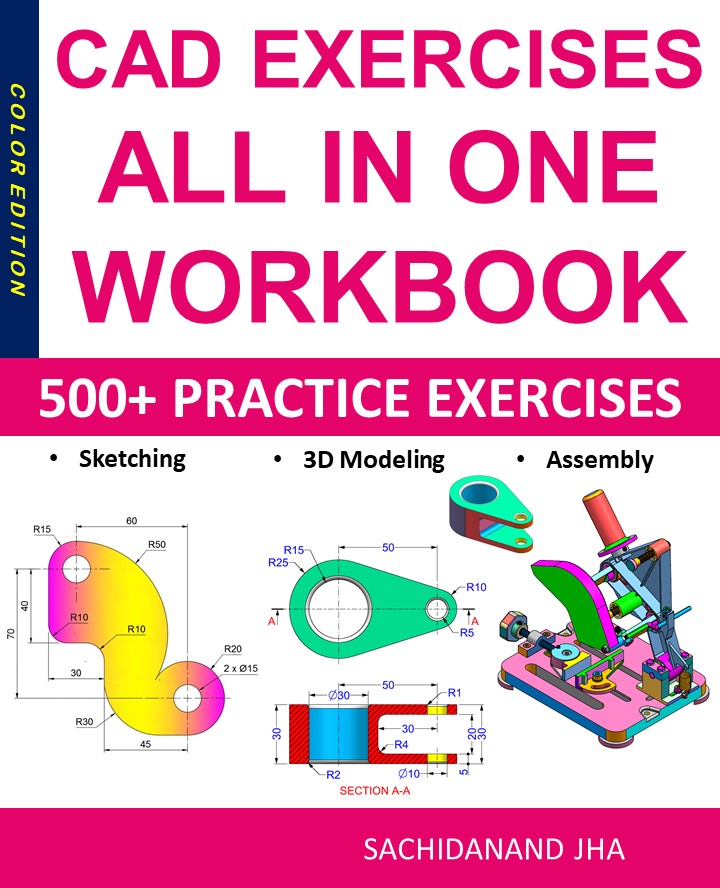
FREECAD All-in-One Workbook
500+ Practice Exercises to Master FreeCAD through real-world practice!
This all-in-one workbook is your ultimate resource to develop hands-on CAD skills with FreeCAD. Whether you’re a student, engineer, hobbyist, or professional, this guide is built to help you gain real design confidence through structured practice.
What’s Inside this Book:
- 200 2D Sketching Exercises – Build a strong foundation in dimension-driven 2D geometry and technical drawings
- 200 3D Modeling Exercises – Practice modeling real-world parts, from simple shapes to complex components.
- Multi-Part Assembly Projects – Understand how parts fit together and create full assemblies with detailed drawings
🎯 Why This Book?
- 500+ practice exercises following real design standards
- Designed for self-paced learning & independent practice
- Perfect for classrooms, technical interview preparation, and personal projects
- Covers 2D Sketching, 3D Modeling & Assembly Design in one workbook
- Trusted by 15,000+ CAD learners worldwide